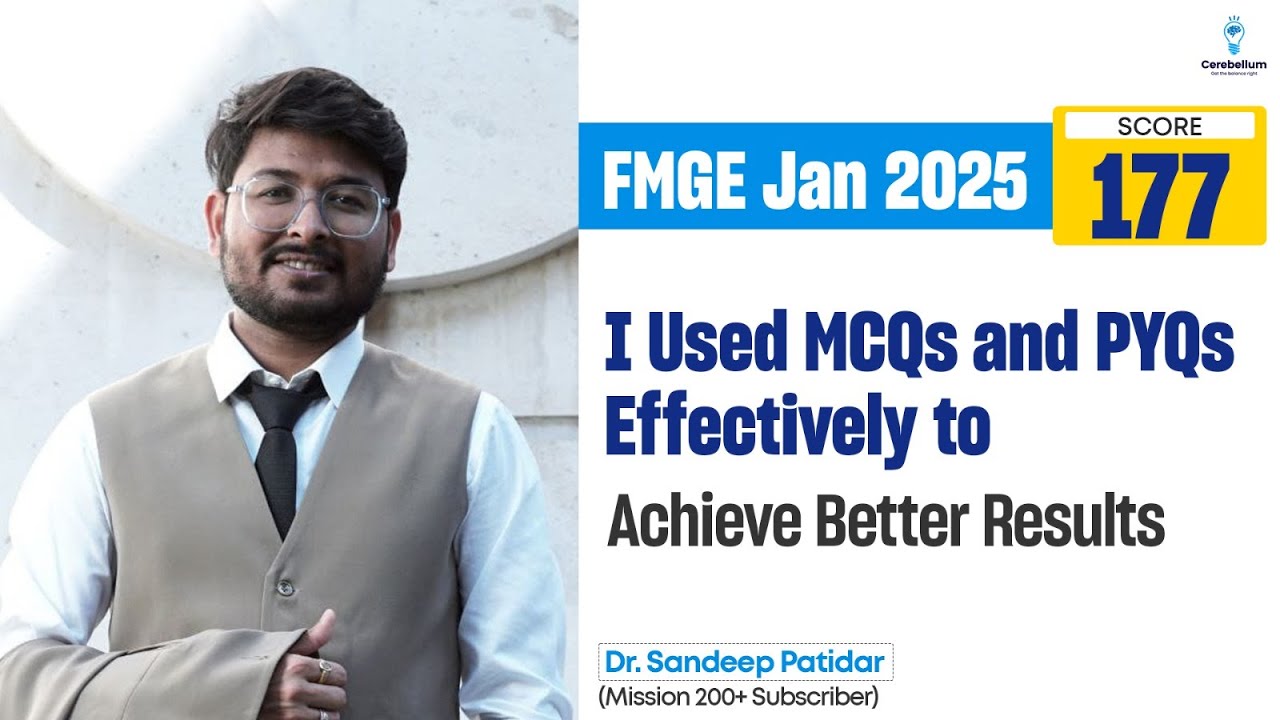

One of the biggest questions students ask is: “What should I do about Grand Tests? My score is stuck.”
Here’s the truth most students respect the GT score, but they don’t respect the GT itself. And that’s where the problem begins.
If you’re giving a Grand Test casually on your phone, half-distracted, pausing between then your score will reflect that mindset. If you want your score to matter, you must treat the GT like the actual exam. Your life depends on it.
Watch the full detailed explanation here:
Step 1: Treat Every GT Like the Real Exam
It doesn’t matter whether it’s:
- A baseline GT
- A mid-schedule GT
- Or one just before the exam
Every GT is 200 MCQs done in a stretch. That’s match practice. And match practice is everything.
GTs prepare you for:
- New, unheard-of MCQs
- Unpredictable twists
- Questions you’ve never seen before
In the real exam, half the panic comes from unfamiliar questions. But if you’ve faced that discomfort repeatedly in GTs, it won’t feel new. You’ll know how to eliminate options. You’ll know how to connect dots.
Even if you “don’t know” a question, you must think:
- What do I know about this topic?
- Can I eliminate two options?
- Which option logically fits better?
Use every ounce of knowledge from your MBBS years. GTs train you to think under pressure.
Step 2: Pre-GT Ritual – Revise Before You Start
Before giving a GT:
- Revise your volatile notes.
- Go through your “Choti Copy.”
- Quickly scan high-yield areas.
Do exactly what you would do before the actual exam. That mental seriousness changes performance.
Step 3: Give 100% Brain During the Test
At the end of a 3-hour GT, you should feel mentally exhausted.
If you finish and still feel fresh, you probably didn’t give your full focus.
A properly attempted GT should drain your brain — because you were thinking, applying, analyzing every question deeply. That intensity builds exam stamina.
After the GT?
Take a one-hour break. Relax. Reset. Then come back for analysis.
Step 4: Smart GT Analysis (3-Hour Rule)
If the GT was 3 hours, analysis should also take about 3 hours. Not more.
Start with wrong answers first and categorize mistakes into three types:
You Knew It but Forgot It
Add this to your “Choti Copy” only if you forget it twice.
Completely New Concept
Add it to your BTR or core notes.
Silly or Interpretation Error
Understand immediately why it happened. Learn the lesson there and then. No need to write it elsewhere.
Correct answers?
Only read if the explanation adds value. Otherwise, scroll quickly.
If review is taking too long, it means too many mistakes are happening. Reduce wrong answers reduce review time.
Step 5: Frequency of GTs
One GT every 10 days is ideal at any stage of preparation.
Each GT = 200 learning opportunities.
Three GTs = 600 MCQs.
That’s 600 chances to improve.
Remember this:
Questions are not testing tools. They are learning tools.
You will remember concepts better when you’ve solved a question on them.
Step 6: Score Stuck at 100–120? Here’s What It Means
If you are scoring:
- Below 100 → Content coverage is incomplete.
- 100–120 → Content is done. Application is weak.
- Above 120 → Improvement comes from heavy MCQ practice.
If you’re stuck between 100–120, don’t run back to videos.
Work on:
- 50–100 MCQs daily.
- Daily custom modules.
- PYQs consistently.
Application improves only through exposure. The same concept can be asked in three different ways. Unless you’ve seen those variations, you won’t improve.
Beyond 120, scores rise because of practice — not passive video watching.
Step 7: Understanding Baseline GTs
If three GT scores are similar (for example, 125–130 repeatedly), that’s actually a good thing.
In PSM terms, that’s precision reproducibility.
If your scores jump from 90 to 170 randomly, that’s unstable. Precision matters first. Once consistent, you push the entire range upward.
So don’t panic if scores are “stuck.”
Stability is your starting point.
Step 8: What If You’re Starting Late?
Before upcoming GTs, quickly revise:
- Long subjects (Medicine, Surgery, OBG)
- Integrated systems
- Core BTR modules
Even watching key topics 2–3 times helps build familiarity before baseline GTs.
Final Takeaway
Grand Tests are not about judging yourself.
They are about training your brain.
Give them seriously.
Review them intelligently.
Practice daily MCQs relentlessly.
If you respect the GT process, the score will automatically rise.
Remember — every MCQ you solve is one more synapse formed, one more mistake reduced, one step closer to your rank.