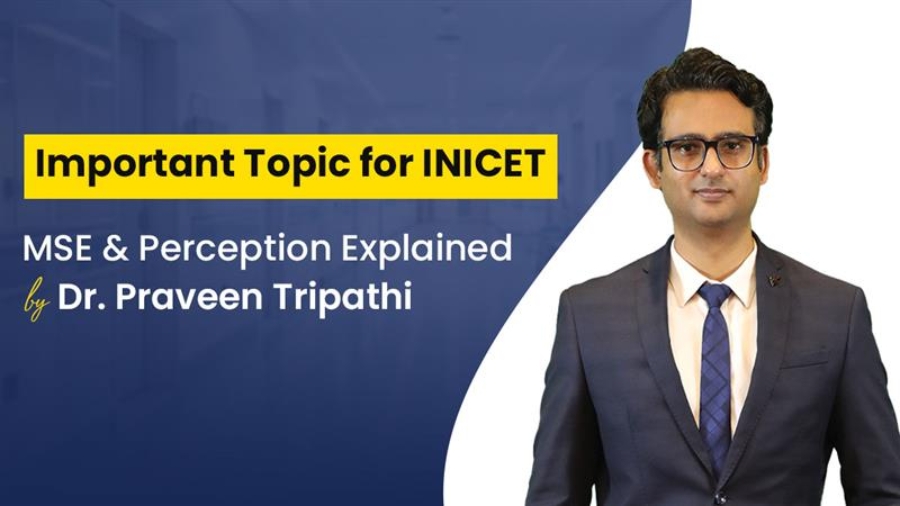
When it comes to psychiatry for INICET or NEET PG, some topics keep coming back again and again. One of them is the Mental Status Examination (MSE)—a concept that looks simple but is packed with high-yield questions.
Let’s break it down in a way that actually sticks.
A Question You’ve Probably Seen Before
One of the classic repeat questions:
Who coined the term “psychiatry”?
👉 Johan Christian Riehl
This is one of those one-liners you don’t want to miss in the exam.
How a Psychiatric Case Begins
Imagine you’re sitting in OPD and a patient with a psychiatric complaint walks in.
What’s your first step?
👉 History taking
Just like any other branch of medicine, history taking is the foundation. But psychiatry has one important twist.
The Role of the Informant
In psychiatry, the informant is crucial.
- The patient is an informant
- But so are relatives, friends, or caregivers
Why?
Because many psychiatric patients may lack insight or may not give reliable history. That’s where the informant fills the gaps and helps you reach the correct diagnosis.
The Most Important Exam Point
After history and general examination, comes the core psychiatric evaluation.
👉 What is the clinical examination in psychiatry called?
Answer: Mental Status Examination (MSE)
⚠️ Don’t confuse this with MMSE (Mini Mental Status Examination)
- MMSE → Screening tool (for dementia, delirium)
- MSE → Full clinical psychiatric examination
This distinction is frequently tested.
Components of MSE – Start With Emotions
Just like general medicine has inspection, palpation, percussion, and auscultation, psychiatry has its own structured format.
The first and most important component:
Mood and Affect
- Mood → Long-term emotional state
- Affect → Short-term, outward expression
👉 Simple way to remember:
Mood = sustained
Affect = immediate expression
Though in exams, these terms may sometimes be used interchangeably—so don’t get confused.
High-Yield Emotional Abnormalities
Now comes the part where questions are often framed.
1. Euphoria
Definition: Excessive happiness without any reason
- If you get a great rank and feel happy → normal
- If you perform poorly but are still overjoyed → abnormal
👉 Seen in: Hypomania / Mania
2. Affective Flattening
This is a very important and commonly tested concept.
What happens?
There is a lack of emotional response.
- Good news → no happiness
- Bad news → no sadness
👉 Emotions become “flat”
How do you identify it?
Ask family members:
- “Does he feel happy during festivals?” → No
- “Does he feel sad during crises?” → No
👉 Seen in: Schizophrenia
3. Anhedonia
Definition: Loss of pleasure in previously enjoyable activities
- Earlier enjoyed cricket, movies, friends
- Now nothing feels enjoyable
👉 Seen in:
- Depression
- Schizophrenia
Why This Topic Matters for INICET
MSE is not just a theory topic—it’s a clinical thinking framework.
Questions can be asked as:
- Direct definitions
- Clinical scenarios
- Difference-based MCQs (MSE vs MMSE)
- Disorder associations
If you understand it once properly, you’ll be able to solve multiple questions easily.
Conclusion
A mental status examination is one of those topics that rewards clarity over memorization. If you understand how a psychiatric evaluation flows—from history to informant input to emotional assessment—you won’t just remember it; you’ll apply it.
For INICET, focus on:
- Basic definitions (MSE, mood, affect)
- Key differences (MSE vs MMSE)
- Clinical associations (euphoria, anhedonia, flattening)
These are small concepts, but they carry high exam weightage.
Mastering them now can save you marks later—exactly where it counts.
To watch more important topics for INICET exam, subscribe to the Cerebellum Academy.