


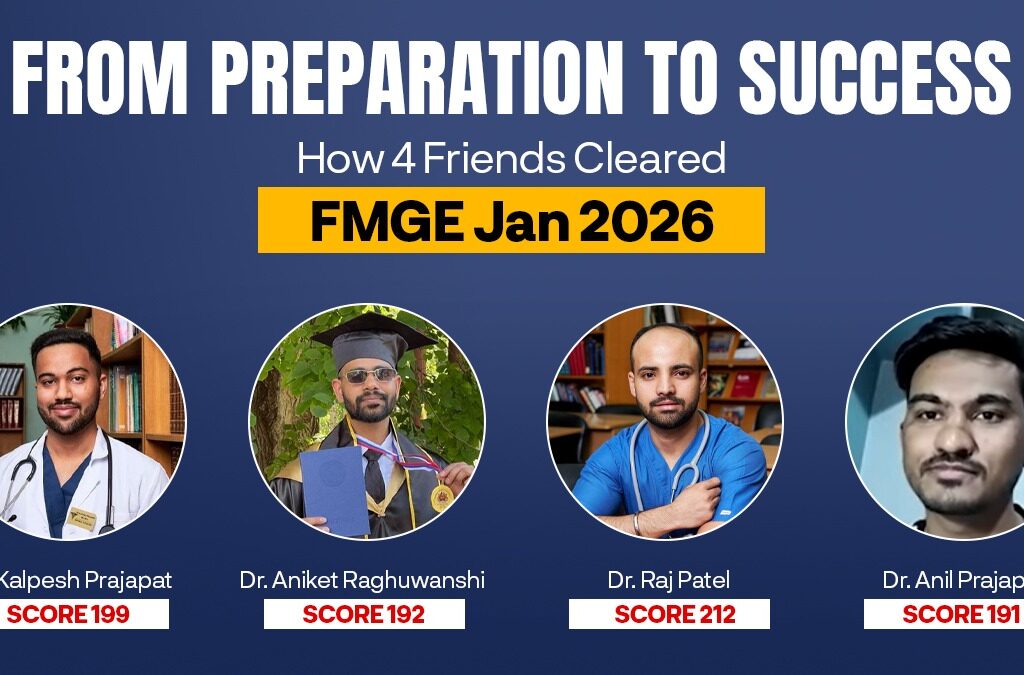
When results of the recent FMG Screening Test were announced, many individual success stories emerged. But this one was different. It wasn’t about one topper. It was about four friends who cleared the exam together with remarkable scores — and proved that collective effort can create extraordinary results.
Dr. Anil Prajapat (191), Dr. Kalpesh Prajapat (199), Dr. Aniket Raghuvanshi (192), and Dr. Raj Patel (212) didn’t just pass. They performed brilliantly. But more than their marks, it was their journey that stood out.
Watch their full inspiring interview here
A Friendship That Started Generations Ago
Dr. Anil and Dr. Kalpesh, both from Banswara, Rajasthan, share a bond that goes beyond friendship. Their grandfathers were friends. Their fathers are friends. And they have studied together since nursery — from school to Kota preparation days, and eventually to MBBS abroad at Crimean Federal University in Russia.
What started as family proximity became a lifelong academic partnership.
Dr. Aniket (Guna, MP) and Dr. Raj (Bhagalpur, Bihar) met at the Delhi airport on their way to Russia. Two students, traveling abroad for the first time, unsure about English, unsure about the future but certain about one thing: they would not do it alone.
From that moment, the four of them became inseparable.
Studying Abroad, Preparing with Purpose
During their third year, the Russia-Ukraine conflict forced them to return home temporarily. That break became a turning point. Instead of waiting, they decided to begin structured FMG preparation early.
They explored resources, discovered Cerebellum Academy, and committed fully — live classes, recorded lectures, E&D sessions, Grand Tests, late-night PYQs, custom modules — nothing was skipped.
Their strategy was simple:
- Finish core videos seriously.
- Revise systematically (Lab 1, Lab 2, Lab 3).
- Attempt every GTE.
- Discuss daily performance as a group.
They would compare scores, analyze mistakes, share mnemonics, and push each other. If one felt low, the others stepped in. If someone’s marks dropped, the group rallied.
They weren’t competing against each other. They were competing against the exam — together.
The Power of Consistency
Their GTE scores fluctuated. Self-doubt was common. Graphs went up and down. But they never stopped.
Dr. Raj shared that his mid-preparation scores were lower than the others. Instead of giving up, he pushed harder in the final months. That consistency helped him cross 200 in the final exam.
Dr. Anil faced admit card issues just before the exam. That emotional stress could have derailed him. But he made a conscious decision — “If I sit for this exam, I will pass.” That mental switch changed everything.
Even during health setbacks like dengue, classes were continued via recordings. Revision was prioritized over panic. In the last 15 days, complete note revision was ensured.
They treated every GTE like the real exam. They never missed one.
Family: The Silent Backbone
Behind these four doctors stood strong families.
Meals were adjusted. Noise was minimized. Social functions were skipped. Parents silently ensured that their only job was to study.
As Dr. Anil reflected, success is never individual. Parents often sacrifice more than the students realize.
The lesson is clear: never forget the invisible support system behind visible success.
Handling Doubt and Depression
All four admitted they had self-doubt — even after the exam.
Preparation isn’t a straight line. Marks fluctuate. Anxiety builds. Thoughts like “What if one of us doesn’t clear?” were common.
Their solution?
Communication.
Instead of isolating themselves, they talked openly in their small group. Sometimes they didn’t even need solutions — just reassurance that they weren’t alone.
That emotional safety net prevented burnout.
Trusting the Process
There were moments when they wondered whether to explore other resources. But they made a conscious choice: trust one system fully.
They emphasized three pillars:
- Revision is non-negotiable.
- Practice tests simulate pressure.
- Group discussion strengthens retention.
Late Night PYQs felt like “magic practice.” In the real exam, many questions felt familiar — modified, yes, but conceptually aligned.
Preparation built confidence. Confidence built performance.
Breaking Stereotypes
Coming from villages and small towns, they faced societal skepticism. Many believed FMG couldn’t be cleared in the first attempt.
They chose to break that belief.
Clearing the exam in the first attempt with such high scores wasn’t just personal success — it was a statement.
Looking Ahead: NEET PG and Beyond
Although their incredible journey doesn’t stop here. The goal has now shifts to NEET PG. But the mindset remains the same along with collective effort, disciplined revision, and mutual growth.
They even dream of building the healthcare infrastructure together in the future, which is possibly creating opportunities for other doctors as well.
That’s the power of thinking as a team.
Final Takeaway
This story isn’t just about four doctors clearing an exam.
It’s about:
- Generational friendship.
- Trust in preparation.
- Emotional resilience.
- Family support.
- Collective growth.
In a competitive field where students often isolate themselves, these four proved something powerful:
You don’t have to win alone.
Success multiplies when preparation is shared.
Friendship should be permanent. Hard work should be consistent. Gratitude should be lifelong.
And when all four friends walk out of the exam hall victorious that’s not just a result. That’s a legacy.