


As you all know FMGE exam is 4 months away and preparing for FMGE isn’t just about how much you study it’s about how effectively you revise. As June 2026 gets closer, your energy should stop going toward collecting new study material and start going toward locking in what you already know.
If you use them the right way, quick revision books can honestly be the thing that separates a pass from a fail in the final stretch. Here’s how to actually use them for FMGE June 2026 not just own them.
Why Quick Revision Is the Real Game-Changer for FMGE
Ask anyone who’s cleared FMGE and they’ll tell you the same thing it wasn’t the first read that did it. It was the third, fourth, fifth quick revision in the last few months that made concepts stick.
FMGE tests three things:
- Concept clarity
- Clinical application
- Memory recall when you’re sitting in that exam hall under pressure
You don’t need 10 different sources of study material. You need 1–2 solid resources revised multiple times. That’s exactly the gap that concise revision notes and rapid revision books are built to fill.
What Makes Quick Revision Books Effective?
Good quick revision books aren’t just shorter versions of textbooks. When they’re well-structured, they:
- Pull out the high-yield topics so you’re not hunting for them
- Present information in a format you can actually get through quickly
- Mark Previous Year Questions (PYQs) so you know what’s been tested before
- Organize subjects in a way that makes rapid recall possible
- Take the edge off exam anxiety because you know exactly where everything is
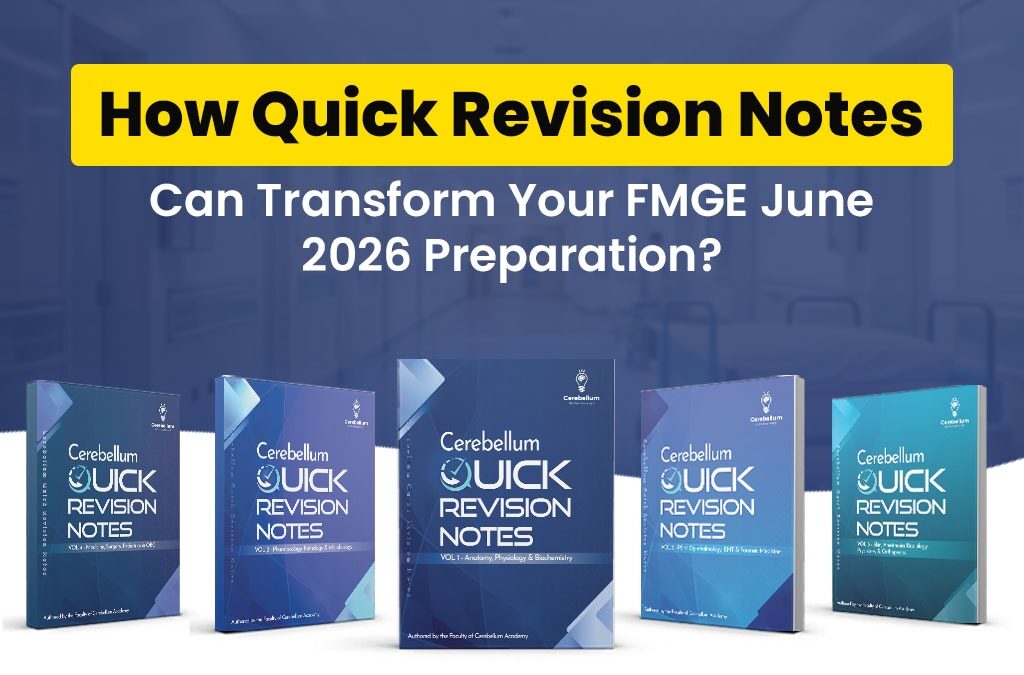
For example, Cerebellum Quick Revision Notes come in a set of 6 subject-wise volumes, which makes systematic quick revision far more manageable than jumping between scattered study material.
Subjects Covered in Cerebellum Quick Revision Notes Volumes
The Cerebellum Quick Revision Notes a well-organized 6-volume set of rapid revision books — typically covers:
- Volume I: Anatomy, Biochemistry & Physiology
- Volume II: Pharmacology, Pathology & Microbiology
- Volume III: PSM, Ophthalmology, ENT & Forensic Medicine
- Volume IV: Surgery, Pediatrics & OBG
- Volume V: Skin, Anesthesia, Radiology, Psychiatry & Orthopedics
- Volume VI: Medicine
To see how structured and exam-focused these quick revision notes actually are, you can check the sample pages of all 6 volumes.
How to Revise for FMGE June 2026 Using Quick Revision Books
Round 1: First Consolidation (4–5 Months Before Exam)
Goal: Strengthen conceptual recall
This is where you build your base. Don’t rush it.
- Work through 2–3 subjects per week using your quick revision notes
- Focus on actually understanding the highlighted points, not just reading past them
- Solve MCQs alongside each topic as you go
- Write personal notes in the margins this turns the revision notes into your customized study material
- Keep the quick revision book as your primary reference, not a backup
Round 2: Second Rapid Revision (2–3 Months Before Exam)
Goal: Build speed and improve retention
By now you’ve seen everything once. This round is about moving faster and making it stick deeper.
- Aim to finish one full volume of your rapid revision books every 3–5 days
- Zero in on the marked PYQs inside your revision notes
- Go through high-yield tables and flowcharts — these are often where marks are won or lost
- Start taking weekly full-length mock tests
- And this part is important — stop adding new study material at this stage. Whatever you have is enough. Work it harder.
Round 3: Final Power Revision (Last 30–40 Days)
Goal: Maximum recall with minimum stress
This is not the time to learn new things. This is the time to make sure everything you’ve already learned is right at the surface.
- Revise only from your marked quick revision books
- Focus on three things specifically:
- Red-marked PYQs in your revision notes
- Yellow-highlighted ultra-important tables from your Cerebellum Quick Revision Notes
- The short notes you added yourself
- Take mock tests every 3–4 days
- Analyze your mistakes right away — don’t let them sit
Done right, this phase doesn’t just improve your score. It genuinely builds the kind of confidence that holds up on exam day.
How Quick Revision Notes Help in FMGE
- Condensed format means faster recall when you’re under exam pressure
- Repeated use of quick revision books makes high-yield topics feel second nature
- Covering study material systematically kills last-minute panic
- Rapid revision books don’t replace textbooks — they consolidate them
- Flip through your quick revision notes and can’t recall something? That’s exactly where you need to spend more time
Smart Tips to Actually Use Quick Revision Notes Well
- Don’t just read the page — cover it and try to recall. Active recall beats passive reading every time.
- Mark the areas in your revision notes where recall is weak and keep coming back to them.
- Don’t skip PYQs — they show you the pattern of what gets asked, which is worth more than random study material.
- In the last 15 days, treat your Cerebellum Quick Revision Notes like they’re the only thing that exists.
The goal isn’t to study more study material. The goal is to retain more from the right quick revision books.
FMGE June 2026 Daily Revision Plan
- Morning: Work through one subject section from your quick revision notes
- Afternoon: Solve MCQs from that same subject
- Evening: Go back over PYQs and marked high-yield points in your revision notes
- Night: Quick recall of everything covered that day using your rapid revision books
You don’t need marathon study sessions. You need this, done consistently, every day.
Final Thoughts
FMGE June 2026 will reward people who are clear, consistent, and strategic — not people who hoarded the most study material.
If you start now and use quick revision books like Cerebellum Quick Revision Notes properly:
- 3–4 complete rounds of quick revision are genuinely achievable before June
- Recall starts happening automatically rather than feeling forced
- Your confidence going into the exam is built on something real
At the end of the day, clearing FMGE isn’t about how many books or how much study material sat on your desk. It’s about how many times you went back to the right revision notes.